


Would you prefer a printable PDF? Sign up here to get PDF copies of these letters by email.
Valerie Kisaber
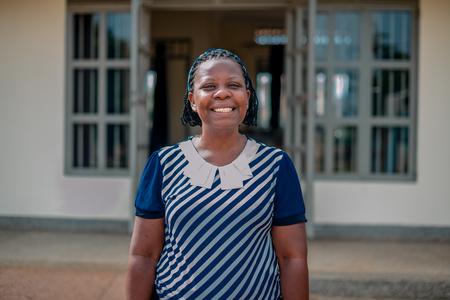
February, 2026
Breaking the Silence – A Story of Hope Beyond Domestic Violence
As we continue strengthening gender mainstreaming across our programmes and communities, it is important to remember that behind every statistic is a real person, a real family, and a real story.
Today, I share a short story that reflects the realities many women and children face particularly in Northern Uganda, and the hope that is possible when support systems work.
Lately, a lot of my energy has been going into strengthening gender mainstreaming across programmes, especially making sure it is not just a checklist but something that truly shapes how we design and implement activities.
One key focus has been supporting faith and cultural leaders to take more ownership in GBV prevention and response. We've made progress here. After the last round of training, a few leaders have started integrating protection messages into sermons and community dialogues without being prompted. This shift—from external facilitation to local ownership—has felt significant. It tells me the work is moving beyond workshops and into real practice.
I've faced a challenge that I've mentioned before: linking protection work with economic empowerment in a meaningful way. We've seen cases where survivors report violence, receive support, but later withdraw because they are financially dependent. This has pushed us to rethink our approach. We are now intentionally coordinating more closely with livelihoods teams so that referrals don't end at psychosocial or legal support, but extend to economic resilience.
The big picture of everything I'm doing: Building systems that protect women and children, while nurturing community responsibility so the work continues even when we step back.
It's layered work—case follow-up, mentoring staff, community engagement. Some days feel like slow progress. Other days, one small breakthrough makes it all worthwhile.
If I had to focus on one thing right now, it would be strengthening referral pathways so that when a case arises, the response is immediate, coordinated, and survivor-centered. That's where impact becomes visible.
Oh the season I am in right now is real life in full color.
First, my son has had malaria. There's something especially heavy about watching your child lie weak and feverish. Even when you know malaria is common and treatable, it still shakes you. You find yourself checking their temperature again… listening to their breathing at night… praying quietly while pretending to be strong. He is responding well to treatment and regaining his energy. That moment when they start asking for food again or wanting to play—that's pure relief.
And my baby girl is crawling away everywhere! That's such a beautiful chaotic stage. One minute she's exactly where i left her, the next minute she's halfway under a chair like she's training for a tiny marathon. That “everywhere” phase means growth, curiosity, and milestones… but it also means i don't sit down properly anymore. Ever!
I am grateful.I am tired.I am alert all the time.I am juggling ministry, protection work, and motherhood.I am praying through fevers.
And maybe I am learning again that strength doesn't always look big and dramatic. Sometimes it looks like crushing medicine into a spoon, being awake in the middle of the night, and still showing up for work the next morning.
A local leader took responsibility and reported a domestic violence case after a training session was conducted in his community. This shows that the system worked without us being physically present. That's sustainable impact.
But I will also share the challenge: Despite awareness efforts, we still see women withdrawing cases due to economic dependence. It's hard to celebrate justice mechanisms when survival needs push survivors back into unsafe situations. This has made us wrestle with how to better integrate livelihoods into protection work. Training alone is not enough. Legal response alone is not enough. Economic resilience is part of safety.
In gender and child protection work, I used to think that awareness and training alone could create lasting change. If people understood the harm, surely they would change—right? But I've seen situations where communities in the Northern part of Uganda know that domestic violence is wrong, yet it continues. That has made me pause.
1. Change is slower and deeper than information. Behavior is tied to identity, culture, economics, and power. Challenging harmful norms requires patience, relationship-building, and long-term engagement—not just workshops and policies.
2. Healing matters as much as justice. I've come to appreciate that survivors—and even perpetrators—often carry deep wounds themselves. Accountability is essential, yes. But without healing, cycles repeat. That has changed how I approach case management and community dialogues. I listen more. I judge less quickly. I ask what pain might be sitting underneath the behavior.
There have also been moments where I've had to rethink my assumptions about “strong women.” Strength doesn't always look loud or confrontational. Sometimes strength is a quiet decision to seek help. Sometimes it is staying long enough to plan safely. Sometimes it is leaving.
And personally, I've been reminded that as professionals, we cannot pour from an empty cup. Burnout can subtly harden compassion. Protecting our own well-being is not selfish—it sustains the mission.
1. Pray for God to move in the hearts of the men in the families
2. Pray that God will give us wisdom when handling cases of violence in families
3. Pray for unity and commitment especially for parents
4. We ask God to protect the children in violent homes
Moving Forward
I reaffirm my commitment to:
Support survivors through safe and confidential reporting systems, promote positive masculinity and shared household responsibility, build economic resilience for women, Work collaboratively with faith, cultural, and local government structures.
Domestic violence is not a “private matter.” It is a human rights issue, a development issue, and a child protection issue.
We will continue to build communities where homes are places of safety, dignity, and mutual respect.